
St. Joseph’s Church and Cathedral, Kuching
阅读中文版
In 1891, two landmark buildings were completed along Kuching’s Rock Road. The first was the Sarawak Museum, which opened on the 4th of August, followed by the St. Joseph’s Church less than a kilometre away, on the 1st of November.
The construction of St. Joseph’s Church cost $510,200. The interior measured 100 feet long, 44 feet wide, and 47 feet high, accommodating about 300 worshippers. Its twin spires, each 80 feet tall made it a fine example of Neo-Gothic architecture. The project employed a team of Chinese labourers, who built it primarily from sturdy belian (ironwood) and red brick. The sanctuary featured black, yellow, and red tiles imported from the Netherlands, with stained-glass windows from Tyrol that depicted St. Joseph, St. Peter, St. Paul, and St. Francis Xavier.
The completion of this church marked a major milestone—ten years since the Roman Catholic Church had first established itself in Sarawak.
Catholic missionary work in Borneo dates to the 16th century, when Portuguese and Spanish missionaries landed on the island. However, for centuries, little progress was made until 1855, when Don Carlos Cuarteron persuaded the Congregation for the Propagation of the Faith in Rome to establish the Apostolic Prefecture of Labuan and North Borneo. He became its first Prefect Apostolic and personally funded missionary work that laid the groundwork for future missions. It is said that Cuarteron wrote to the second White Rajah, Charles Brooke, expressing his wish to evangelize in Sarawak. But since the Anglican Church was already active there, the Rajah declined Cuarteron’s request to avoid interdenominational conflict.
In 1880, due to ill health, Father Cuarteron retired to Spain. The St. Joseph’s Missionary Society of Mill Hill took over the Labuan and North Borneo mission, continuing the Catholic effort in Borneo. The Mill Hill Mission, founded in 1866 by Cardinal Herbert Vaughan in England, was dedicated to overseas evangelization, with missions spread across Africa, Asia, and the Americas.
The Mill Hill missionaries formally wrote to the Rajah seeking permission to begin work in Sarawak. Since the Anglican mission had limited manpower and progress was slow, Charles Brooke agreed in his reply of the 13th of August 1880, permitting the Catholics to operate on the condition that they stayed out of Protestant mission zones and did not attempt to convert Muslims. The Rajah specifically wanted the missionaries to focus on the indigenous peoples of the interior.
On the 19th of March 1881, three young priests—Fr. Edmund Dunn, Fr. Aloysius Goossens, and Fr. Daniel Kilty—sailed from London to Singapore. Fr. Kilty continued to Labuan, while the other two arrived in Kuching on the 10th of July, 1881. A month later, their superior, Fr. Thomas Jackson joined them.
Charles Brooke granted ten acres of land to the Catholic Church, allowing them to begin missionary work and open schools in Kuching. Their initial mission targeted the Bidayuh people of Bau and the Iban along the Rajang River.
In 1885, encouraged by Fr. Thomas Jackson, five nuns arrived in Kuching. They were members of the Sisters of St. Joseph’s Society, founded in 1883 and affiliated with the Mill Hill Mission. More nuns followed in subsequent years. In 1925, the congregation was renamed the Franciscan Missionaries of St. Joseph (FMSJ), and three years later, they helped found the Sisters of St. Francis of Sarawak (SSFS).
Students were required to pay attention in class, behave properly, and speak only English or Malay. They also had to bathe at least once a day and wash every morning. Teachers, meanwhile, were reminded of their educational duty: they were forbidden to sit while teaching, could carry a rattan cane but not use it, and were instructed to show neither favouritism nor prejudice. The strictness of Kuching’s Catholic schools likely traced back to these early rules.
In April 1882, St. Joseph’s School—the first Catholic school in Sarawak—opened its doors as a boys’ school with 20 students in a simple attap hut. Three years later, St. Teresa’s School for girls opened directly opposite.
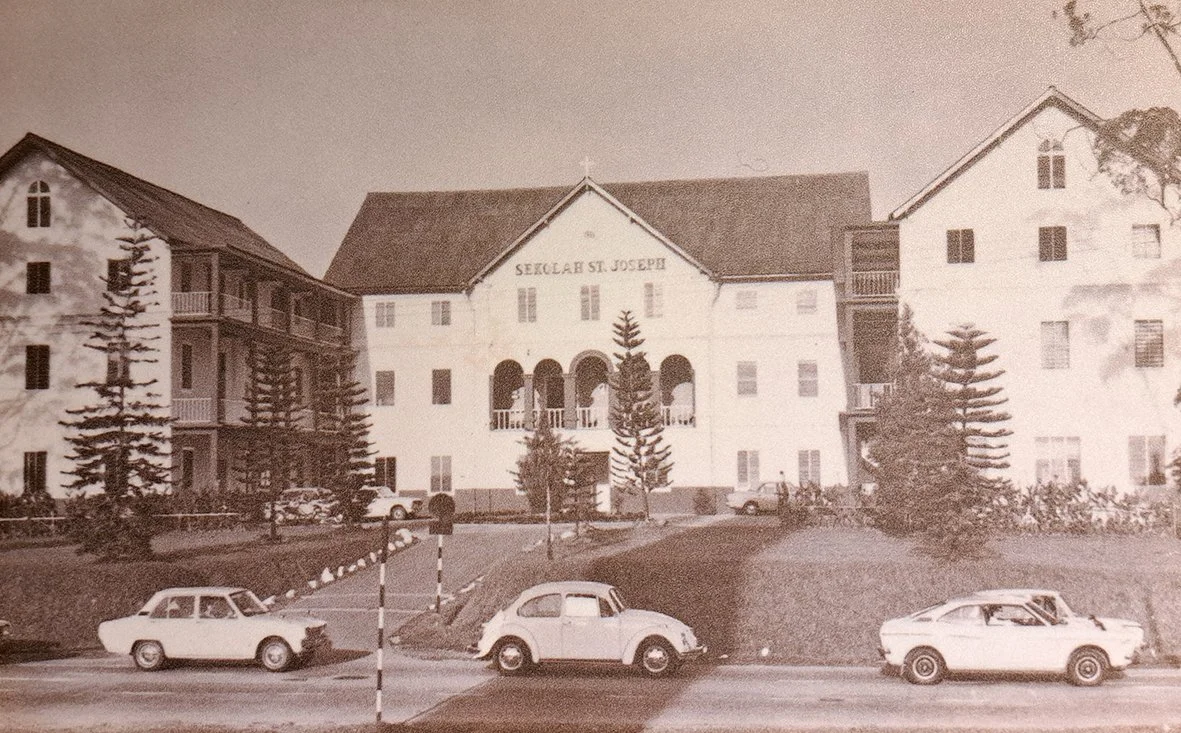
St. Joseph’s School, the first Catholic school. (Photo: The History Gallery of the Archdiocese of Kuching)
Fr. Aloysius Goossens served as St. Joseph’s first headmaster but was succeeded two years later by Fr. Anthony Haidegger, who held the position from 1883 to 1931—a remarkable 48 years. In 1883, Fr. Haidegger issued the school’s first set of regulations governing both teachers and students, some of which seem quaint today.
By the 1960s, the original St. Joseph’s Church had become too small and dilapidated to serve the growing Catholic population. The Church decided to build a new one beside it. The design, initially drawn by Mr. Bradford and later completed by other architects—including the renowned Dr. Paul Yong, who also designed Wisma Saberkas—was conceived as “a tent for the gathering of God’s people.” Construction began in 1966, and the new church could accommodate 1,200 worshippers.
On March 19, 1969, the new St. Joseph’s Cathedral was completed. Its striking “great tent” form featured a cross at the peak. Unlike the old church, the cathedral placed the altar at the centre, allowing the congregation to gather around it from three sides—symbolizing the people of God surrounding the Lord’s table. The old church was demolished in October 1968, and in its place, a 71-foot bell tower with three electric bells was erected.
The Catholic Church established the Apostolic Prefecture of Kuching in 1927, which became a Vicariate Apostolic in 1952 and was elevated to an Archdiocese in 1976. In 1994, St. Joseph’s Cathedral underwent renovation—its roof was replaced, and its interior expanded to hold up to 2,000 worshippers.
Of special note, in 2016 the Church opened the History Gallery of the Archdiocese of Kuching, showcasing a rich collection of documents and artifacts—a must-visit for anyone interested in the history of Catholicism in Sarawak.
Written by Chai Kit Siang
Share this post
