
Red Ribbon Pavilion
World War II Memorial for Sarawak's Volunteer Mechanics and Drivers
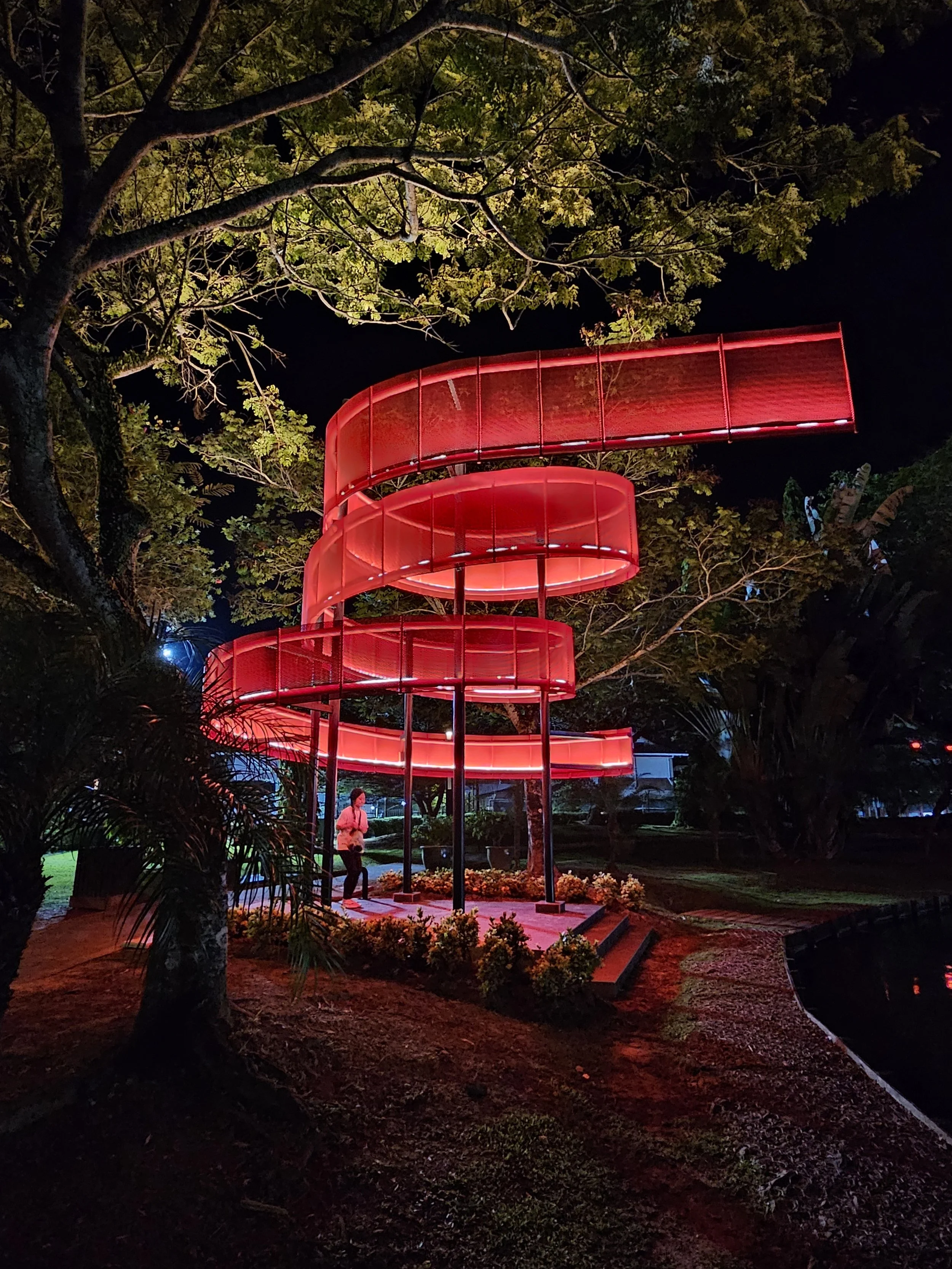
In Malaysia-China Friendship Park, Kuching, a red ribbon folly seems to sway gently in the air. More than just a place, the Red Ribbon Pavilion, by INTODESIGN Lab connects past and present, recalling a pivotal chapter in global history while celebrating the lasting connection between Sarawak, Yunnan, and beyond.
A Lifeline through the Mountains
The inspiration for the pavilion goes back to one of the most central supply routes during World War II: the Burma Road. Built from 1937 to 1938, when Burma was still a British colony, the 1,150-kilometer road connected Lashio in Burma with Kunming, capital city of Yunnan Province. As Japan’s occupation cut off China’s coastal supply lines, the Burma Road became the nation’s lifeline. By way of this treacherous artery, weapons, vehicles, and medical supplies flowed into the Chinese heartland, sustaining the nation’s war of resistance. Its best-known passage: the 24-Turns Road jutting into the mountainside at Qinglong. It has since becomes a sign of hardship and resilience. Mechanics and drivers along this section encountered sheer drops and sharp hairpin bends piled one after another. This is the place where courage and endurance were put to the test every day and where lives were put on the line for something bigger.
Nanyang Volunteers: Sarawak’s Forgotten Heroes
Between 1939 and 1942, there were over 3,200 Chinese drivers and mechanics from Southeast Asia who responded to the call to serve along the Burma Road. Of them, there were more than 100 Sarawak mechanics who signed up for what later became the Nanyang Mechanics Volunteer Corps. The men, many of them untrained and inexperienced, weathered monsoon rains, collapsing bridges, air raids, and harsh terrain to maintain the supply line. In only three years, the volunteers collectively moved over half a million tonnes of military goods across the mountains, and over 15,000 vehicles as well. For Sarawak, theirs is a little-known but deeply moving narrative as one that highlights how even distant communities weighed in to fight fascism globally.
Architecture as Tribute
The Red Ribbon Pavilion embodies this historical narrative through an artistic installation. Rather than serving as a solemn monument, it symbolizes the vitality and perseverance of those who once traversed the Burma Road. The pavilion's form has been inspired by the dramatic contours of the 24-Turns Road. Its ribbon-like structure gracefully extends toward Yunnan, acting as both a physical emblem and a bridge. The design strikes a balance between remembrance and celebration: it serves as both a representation of sacrifice—a red bloodline—and a joyful expression—a red ribbon, while it honors struggle and sacrifice, it simultaneously exudes joy, vigor, and the ongoing flow of life. Consequently, the pavilion avoids the static nature often associated with traditional memorials. Instead, it becomes a vibrant space where history is actively engaged with, allowing visitors to not only reflect but also to converse and celebrate, fostering gratitude for preserving this legacy.
A Beacon of Friendship
Besides its architecture, the Red Ribbon Pavilion celebrates the everlasting friendship between Sarawak and Yunnan. For decades, these regions have sustained ties over time through cultural interaction and education as well as by the people in contact with their neighbors. It is in commemorating Nanyang Mechanics Volunteers that the pavilion deepens this relationship. Shared sacrifice becomes a shared vision of tomorrow. Today it resides not only as an art installation but also a beacon. It ties together history with the present, Sarawak with Yunnan, memory with hope. In so doing, it offers a sense of how architecture, at its most profound, may stitch together history and humanity in one single gesture of design.
PROJECT GALLERY




-
Designer : INTODESIGN Lab
Client : Majlis Bandaraya Kuching Selatan (MBKS)
Area : 36 m²
Project Location : Kuching | Sarawak
Year : 2025 -
Design Team : Tay Tze Yong | Joanne Sia | Wong Jun Xiang
Structural Engineer : Perunding YKN Sdn Bhd
Contractor : Wan Li Wan Welding Works
Photography : Tay Tze Yong
Share this post
